
Lesson page
Page Library
Lesson page
A lesson page for online courses that gives every lesson the same clear shape. It opens with the lesson's objectives, marks where your lesson video goes, lists the materials students need, walks through the technique in numbered steps with tips, sets a practice task and points to the next lesson. The sample is a beginner watercolor lesson on graded washes. Copy the page for each lesson, replace the steps and materials, add your video in the editor, and link the button to your next lesson.
Lesson 2.5: Graded washes
A graded wash moves smoothly from dark to light. It is the foundation of almost every sky you will paint, and once you can do it, you will use it everywhere.
- load your brush with the right amount of paint for a large wash
- add water stroke by stroke so the color fades evenly
- keep a bead of paint moving to avoid hard lines and blooms
Your lesson video goes here. Add it in the editor with the video button, using its YouTube or Vimeo link, and delete this note.
What you need
- A quarter sheet of 140 lb cold-press paper
- A 1 inch flat brush or a size 12 round
- Ultramarine blue
- Two jars of clean water
- A board and masking tape
- Paper towel, and something to tilt your board
Step by step
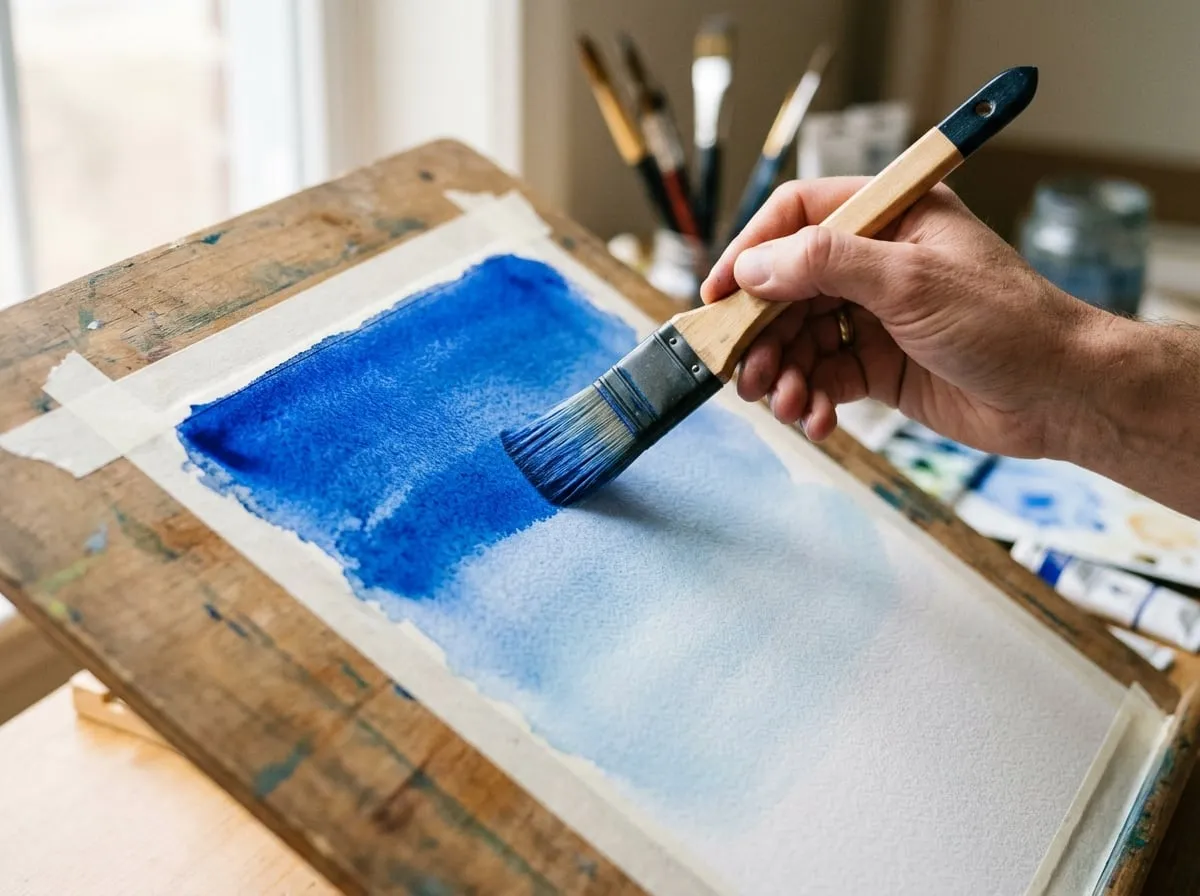
- Tape and tilt. Tape your paper to the board on all four sides and prop the top up about 2 inches, so the paint runs gently downward.
- Mix more than you think. Mix a puddle of strong ultramarine about the size of a coin. Running out halfway is the most common reason a wash fails.
- Paint the first stroke. Fully load the brush and pull one stroke across the top edge. A bead of paint should gather along the bottom of the stroke.
- Dilute as you go. Dip the brush in clean water, touch it to your puddle, and pull the next stroke so it just overlaps the bead. Each stroke has a little more water and a little less paint.
- Finish with clear water. Your last two strokes should be almost clear. Squeeze your brush dry and touch it to the final bead to lift it off.
- Leave it alone. Let the wash dry flat without touching it. Going back into a drying wash causes blooms.
If you see stripes, your strokes were too slow or your brush too dry. Work a little faster, and keep the bead wet the whole way down.
Your practice task
Paint three graded washes side by side: one in ultramarine, one in burnt sienna and one in a mixed green. Do not worry about perfection. Notice which one came out smoothest and why.
When they are dry, photograph them in daylight and post them in the Module 2 thread in the community. Tell us which one you are happiest with.
Lesson 2.6: Six essential brushstrokes
Learn the strokes you will use to paint grass, branches, ripples and petals.
Use this page
Make it yours in a few minutes
- Find it in your Control Panel. Go to Content > Page Library and search for "Lesson page".
- Add it to your site. Choose a title and a department. The page arrives as a draft, with its pictures copied to your site and your site's name already in place.
- Change the words and pictures. Open it in the Membergate editor, replace the sample text and images with your own, and make it live when you are ready.