
Practice routine guide
Page Library
Practice routine guide
A helpful, shareable article for music teachers and lesson sites to publish on their public blog. It shows adult learners how to practice well in 20 minutes a day, with a four-step session, a weekly schedule table that rotates the focus, advice on tempo and tracking progress, and callouts for the most common traps. It works as a lead magnet or a resource you send new students. Change the times and exercises to suit your instrument and teaching method, and keep the closing invitation to try your lessons.
The 20-minute guitar practice routine for busy adults
Most adults don't quit guitar because they lack talent. They quit because practice feels aimless, and aimless practice is the first thing to go when life gets busy. Here's a routine that fits into 20 minutes and actually moves you forward.
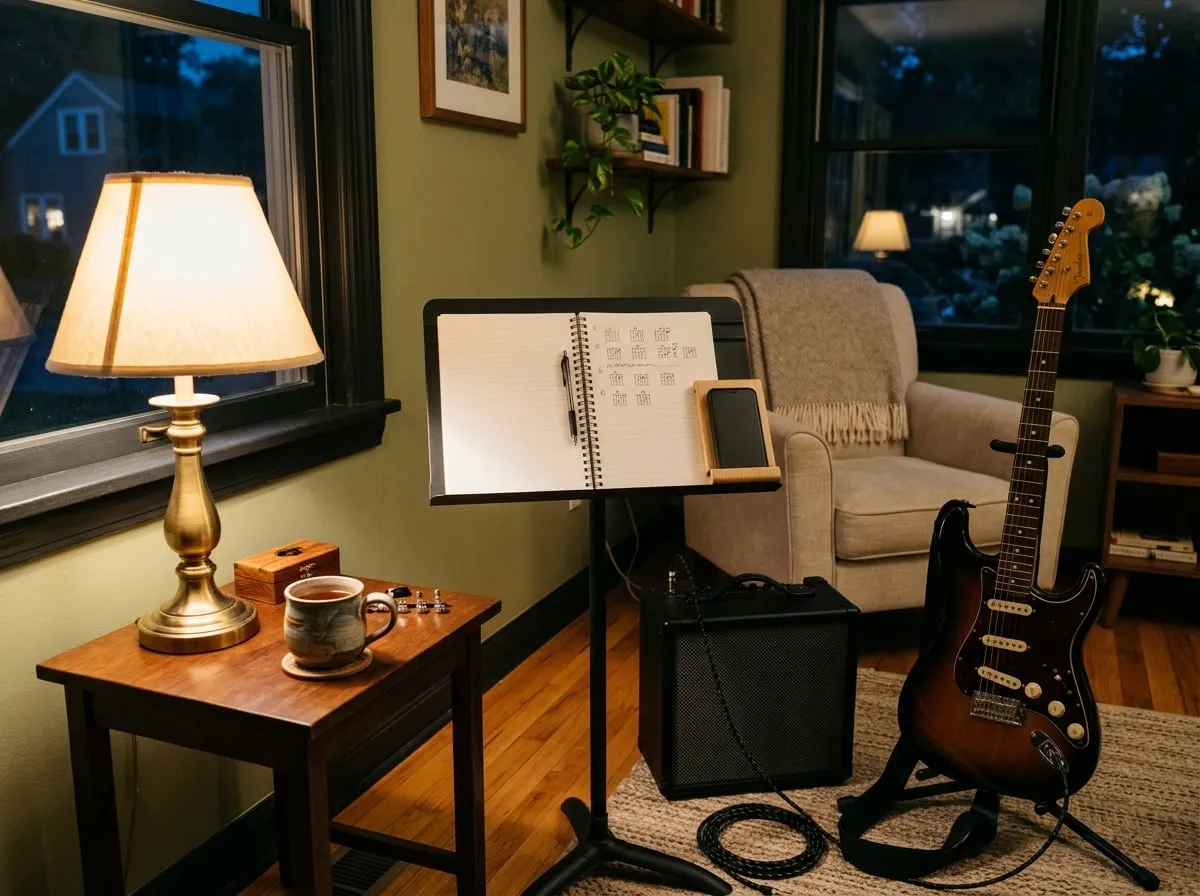
Why 20 minutes is enough
In 25 years of teaching, the students who improved fastest weren't the ones who practiced longest. They were the ones who practiced most often. Your hands learn through repetition and sleep, so five short sessions a week beat one long weekend marathon every time.
The four-part session
Every session follows the same shape, so you never waste the first five minutes deciding what to do.
Warm up (3 minutes)
Slow chromatic finger exercises up and down the neck, or your two hardest chord changes, back and forth. Focus on clean notes, not speed.
Technique (7 minutes)
One specific skill from your current lesson: a new chord, a strumming pattern, a scale shape. Use a metronome and start slower than you think you need to.
Song (7 minutes)
Apply the technique to real music. Work on the hardest four bars of the song you're learning, then play it through once.
Play for fun (3 minutes)
No goals. Noodle, play an old favorite, make up a riff. This is the part that makes you want to pick the guitar up tomorrow.
Put a timer on your phone for each part. It stops you spending all 20 minutes on the fun bit, and it stops you grinding one exercise until you're frustrated.
A sample week
Rotate your technique focus through the week so every skill gets attention. Here's a schedule for a student in their first year:
| Day | Technique focus | Song work |
|---|---|---|
| Monday | Chord changes: one-minute drills | New song: learn the first section |
| Tuesday | Strumming with the metronome | Hardest four bars, slowly |
| Wednesday | Rest, or listen to the song closely | None |
| Thursday | Barre chord or scale practice | Second section of the song |
| Friday | Picking or riffs | Join the sections together |
| Saturday | Review the week's weakest skill | Play the whole song and record it |
| Sunday | Optional: play anything you like | Play along with the original |

Tie it to something you already do
The routine works best attached to a habit you never skip. Play straight after your morning coffee, or before you turn on the TV in the evening. Students who pick a fixed time stick with it three times longer than those who practice "when I get a minute."
Slow down to speed up
When something isn't working, the answer is almost always to play it slower. Find the tempo where you can play it perfectly three times in a row, then raise the metronome by 5 bpm. That's it. It feels painfully slow, and it's the fastest way to get fast.
Sore fingertips in the first few weeks are normal. Pain in your wrist, forearm or shoulder is not. Stop, shake out, check your posture and keep sessions short until it settles. If it doesn't, see a doctor or physical therapist.
Track your progress
Keep a simple practice log. For each session, jot down the date, what you worked on, the tempo you reached and one thing that went well. After a month, you'll have proof of how far you've come, which is exactly what you need on the days it feels like you're getting nowhere.
- Write down your metronome speed for every exercise.
- Record a 30-second clip every Saturday and keep them in one folder.
- Count your clean chord changes in one minute, once a week.
- Celebrate milestones: your first full song, your first barre chord, your first jam.
Nobody gets good at guitar in a weekend. Everybody who sticks with it for a year is amazed at what they can play.
Members of Fretwork Guitar Academy get a ready-made 20-minute plan for every lesson in the course path, plus weekly live Q&A with Marcus. Try it free for 7 days.
Use this page
Make it yours in a few minutes
- Find it in your Control Panel. Go to Content > Page Library and search for "Practice routine guide".
- Add it to your site. Choose a title and a department. The page arrives as a draft, with its pictures copied to your site and your site's name already in place.
- Change the words and pictures. Open it in the Membergate editor, replace the sample text and images with your own, and make it live when you are ready.